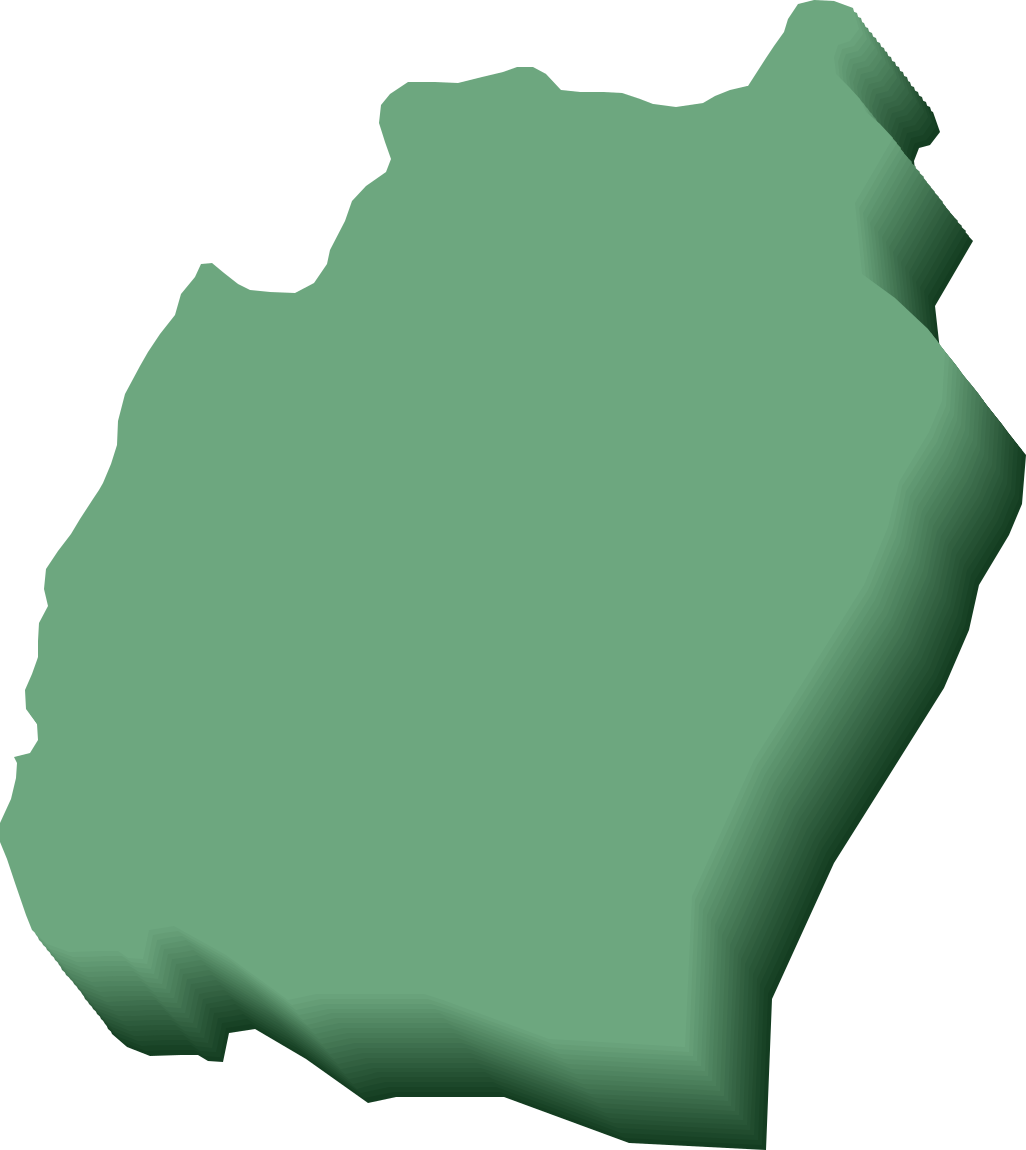
About Chandel District (Manipur)
This district came into existence on 13th May, 1974 as Tengnoupal district. After sometime, in the year 1983 the district headquarter was transferred to Chandel and as a result it was renamed as Chandel district. Originally the place was well known as Chamdil, derived from the two Anal terms (Pakan language) such as cham meaning simple and dil meaning trousers.
Geographically, the district has a total 3,313 sq. km. area and occupies the rank 4th in State and 373rd in India on the bases of this size. It lies at 24°33' N latitude, 94°00' E longitude and 3050 m altitude. In the year 2023, there was a total 86.23% forest area of total geographical area. It is surrounded by Ukhrul District and Thoubal District in the North, by Myanmar in the South and East and Churachandpur District by the West. Akonglong River, Chamu, Chingai, Yu River, Maklang, Tuyonbi, Tareklok, Lokchao, Lalimlok, Tuiyang, Manipur River, Imphal, Iril, Nambul, Sekmai are the major rivers of the district. The climate of the district remains pleasant almost throughout the year. Most of its rainfall occurs in the monsoon season. The actual rainfall in the district was 1100.2 mm in the year of 2024-2025.
Administration wise, the district is divided into 1 town and 437 villages. Meiteilon (Manipuri) is its official language. The district comprises 3 sub-divisions namely Chandel, Chakpikarong and Khengjoy. In the state of Manipur with an allotted district code of 280th district of Chandel came into existence on 13th May, 1974 with its administrative headquarters located at Chandel, situated at a distance of 65 kms from the state capital.
Demographically, according to the 2011 census, the district has a total number of 29,097 households with a total of 1,44,182 comprising 74,579 are males and 69,603 are females which causing it to rank 8th in the state and 601st in India. The density of population of the district is 44 (persons per sq km.). The sex ratio is pegged at 933 (females per 1000 males) while the child ratio stands at 921 (females per 1000 males). Furthermore, the district has projected population of 1,75,828 comprising 91,072 males and 84,756 females for the year 2026. According to the National Family Health Survey (NFHS-5, 2019–21), the district has an estimated sex ratio of 1,077 females and a child sex ratio of 961 females per 1,000 males. The population growth rate during the period 2001 to 2011 was 21.85% including 24.84% were males and 18.80% were females. In the year 2023 the number of live births in the district was 1,434 out of which 697 were males and 737 were females. In the same year the number of deaths in the district was 224 out of which 155 were males and 69 were females. As per 2011 census the major religion in the district is Christian with 89.50% of the total population. According to 2001 census the principal languages in the district are Thado, Anal and Maring with 36.00%, 17.92% and 15.29%.
Economically, the district is dependent on agriculture primarily. In the year 2006-2007 the Gross Domestic Product in the district was Rs. 27,253 lakh at current price and Rs. 24,218 lakh at constant 1999-2000 prices. The Net Domestic Product in the district during the period 2006-2007 was Rs. 24,957 lakh at current price and Rs. 22,502 lakh at constant 1999-2000 prices. The Per Capita Income or NDDP, At Factor Cost in the district during the period 2006-2007 was Rs. 17,625 at current price and Rs. 1,416 at constant 1999-2000 prices. Rice, soybean, mustard, wheat, brad bean, sesame are the main agricultural products of the district. The district is considered as one of the most backward region which is currently receiving funds from the Backward Region Grant fund.
Education wise, according to 2011 census, the literacy rate is 71.11% out of which 77.78% are males and 63.96% are females. The total number of literates in the district is 90,302 including 51,053 are males and 39,249 are females. The total number of illiterates in the district is 53,880 including 23,526 are males and 30,354 are females. In addition, according to the Periodic Labour Force Survey (PLFS) for the period July 2023-June 2024 estimated literacy rate in the district is 90.41% including 94.11% are males and 87.10% are females (Age 7 Years and Above).
Jawahar Navodaya Vidyalaya, Komlathabi Union Model High School, Maha Union Hr. Sec. School, Oriental Academy, L. Kangshang (aided) Public School, M.G. Evergreen High School, Mission Blind School, St.anthony English School, All Community Welfare School, Don Bosco School, Moreh Hr. Sec. School and United College are some of the main educational institutes in the district.
B D Behring is the member of the Janata Dal party. He became the member of the Rajya Sabha from 1990 to 1996 from Manipur. He represented Chandel constituency in the Manipur Legislative Assembly from 1990 to 1995 and from 2000 to 2005.
In the year of 2019-20, there were total 18,897 domestic tourists and 84 foreign tourists who visited here. The district has some famous and beautiful places to visit. These places are Moreh, Yangoupokpi-Lokchao Wildlife Sanctuary and Tengnoupal. The Yangoupokpi-Lokchao Wildlife Sanctuary was established in 1989. Tourists can watch various species of amphibians, reptiles, mammalians, birds and fishes in this sanctuary. Some main animals in this sanctuary are the Hoolock Gibbon, Himalayan black bear, stumped tailed macaque, slow loris, wild bear, pig tailed macaque, Indian civet cat, golden cat, etc. Tengnoupal is a historical place which was under the rule of Pakhangha Rulers. In 1631, the Chinese took over the region. In 1942, Japanese bombarded here. There are two rivers and many lakes. It is the highest point of Manipur. Morch is the favorite place for nature’s lovers and businessman for cross country business. It is a hub for trade. Chinese and Thai goods can be bought from the shopping plaza at Namphanglong.