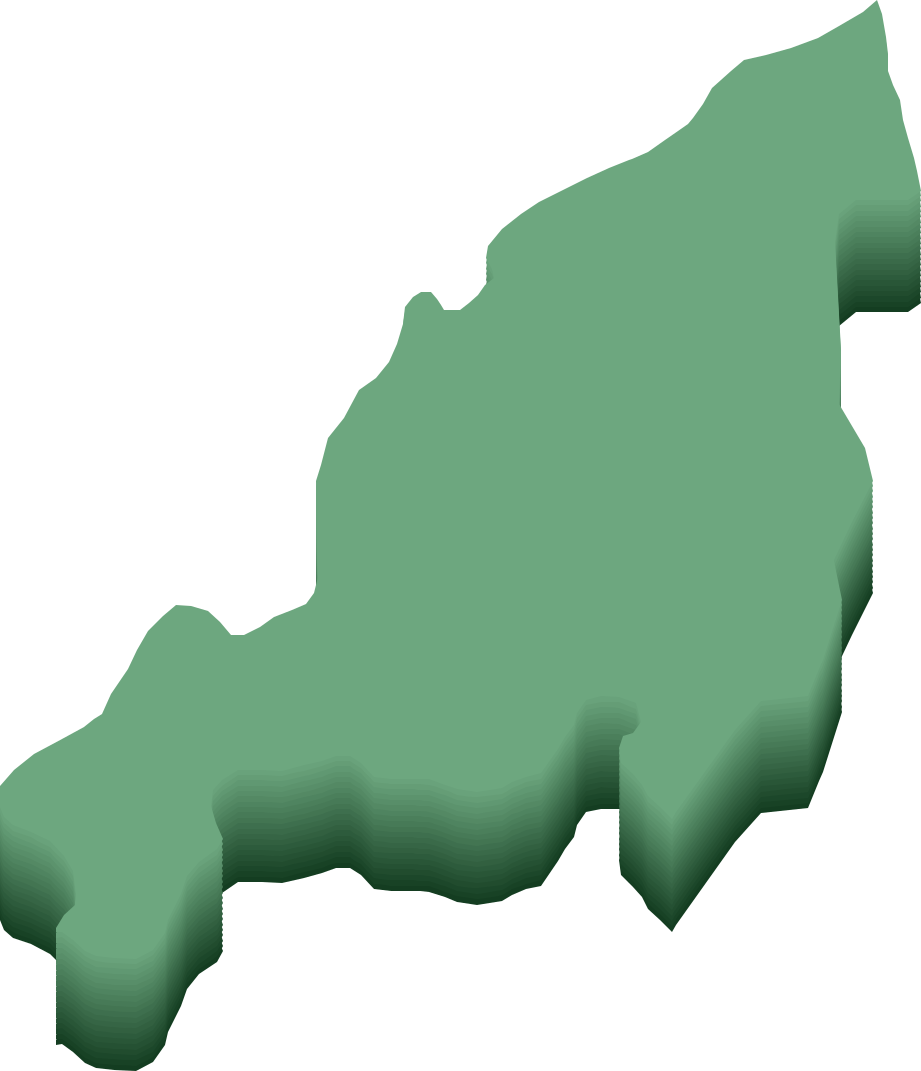
About Longleng District (Nagaland)
Longleng district is a district of Nagaland state with its administrative headquarters located at Longleng town. From the very beginning Longleng district is well known as the Home of the Phom Nagas. Phom are one of the major tribes of Nagaland state. Initially, Longleng was under the district administration of Tuensang district but later on it was bifurcated as a separate and tenth district of the Nagaland state in January 2004.
Geographically, the district has a total area of 562 sq. km. and occupies the rank 11th in State and 611th in India on the basis of this size. It lies at 26°49' N latitude, 94°82' E longitude and 1066 m altitude. In the year 2023, there was a total 68.58% forest area of total geographical area. It is bounded by Mon district in the North, Mokokchung district in the West and Tuensang district in the South. Tamlu and Longleng are the prominent towns in the district. The principal rivers that flow through the district are Dikhu and Yongmon. The actual rainfall in the district was 299.2 mm in the year of 2024-2025.
Administration wise, the district is divided into 5 sub-districts, 1 town and 49 villages. English is the administrative language of the district. The district came into existence in the year 2007 with its administrative headquarters located at Longleng town, situated at the distance of 217 kms from the state capital.
Demographically, according to the 2011 census, the district has a total number of 11,580 households with a total population of 50,484 comprising 26,502 are males and 23,982 are females which causing it to rank 11th in the state and 632nd in India. The density of population of the district is 90 (persons per sq km.). The sex ratio is pegged at 905 (females per 1000 males) while the child ratio stands at 885 (females per 1000 males). As per 2011 census the major religion in the district is Christian with 96.76% of the total population. As per 2011 census the principal languages in the district are Phom and Konyak with 93.68% and 1.83%. Furthermore, the district has projected population of 61,565 comprising 32,362 males and 29,203 females for the year 2026. According to the National Family Health Survey (NFHS-5, 2019–21), the district has an estimated sex ratio of 969 females and a child sex ratio of 900 females per 1,000 males. During the year 2001-2011 the population growth rate in the district was -58.48% including -58.83% were males and -58.08% were females. In the year 2023 the number of live births in the district was 602 out of which 324 were males and 278 were females. In the same year the number of deaths in the district was 115 out of which 46 were males and 69 were females.
The district is mainly dependent on the agricultural sector. The farmers of the district are very much use to the Jhum cultivation. More than half of their populations are engaged in agriculture in order to earn their livelihood. The chief agricultural products in the district are areca nut, banana, garlic, ginger, guava, grapes, chilies, cauliflower, etc. The low lying areas and foothills of the district are so fertile for the wet paddy cultivation. Most of its residents are agriculturists on the other hand very few of its natives are engaged in white collar jobs. The district is scantily industrialized since it has a little number of small scale industries of pottery, bamboo work, spinning, etc. Some other small and medium scale industries are agro based, cotton textile, woolen, silk and artificial threads based cotton, readymade garments and embroidery, wood or wooden based furniture, mineral based and repairing and servicing, etc. In the year 2019-2020 the Gross Domestic Product in the district was Rs. 99,613 lakh at current price and Rs. 62,112 lakh at constant 2011-2012 prices. The Net Domestic Product in the district during the period 2019-2020 was Rs. 85,154 lakh at current price and Rs. 51,043 lakh at constant 2011-2012 prices. The Per Capita Income or NDDP, At Factor Cost in the district during the period 2019-2020 was Rs. 1,54,002 at current price and Rs. 92,312 at constant 2011-2012 prices.
Education wise, according to 2011 census, the literacy rate in the district is 72.17% out of which 74.48% are males and 69.63% are females. The total number of literates in the district is 29,859 including 16,139 are males and 13,720 are females. The total number of illiterates in the district is 20,625 including 10,363 are males and 10,262 are females. In addition, according to the Periodic Labour Force Survey (PLFS) for the period July 2023-June 2024 estimated literacy rate in the district is 89.08% including 95.44% are males and 81.45% are females (Age 7 Years and Above).
The district is well known as an abode of several reputed educational institutions. It provides a platform for higher education. Yingli College, located in the Longleng district is affiliated by the Nagaland University and approved by UGC. Some of the most recognized educational institutions in the district are Bethel School, Christ School, Christain Tamlu School, Christian School, Christian School, Christian Longl English School, Christking School, Evangel Mission School, Gms Nyenching School, etc.
The district has some famous and beautiful places which are not only famous within the country also in the world. The district has a number of mesmerizing natural sceneries, trekking, fishing and picnic spots which allure a number of visitors from the worldwide every year. It offers a very serenity, peaceful environment to their visitors that they feel relax here far away from the disturbance of busy city life. Some of the most notable places of interest in the district are Pongo Village, Bhumnyu Village, etc. The Longleng town also has many beautiful picturesque. Fishing and picnic spots are available along the sides of the Dikhu river and Yongam River. It is a perfect place for archeologists, anthropologists and ornithologists.